
The Tokyo Scoring series has garnered attention from composers worldwide. We spoke with three key figures behind the highly anticipated solo sample library Tokyo Scoring Solo Strings: Masaru Yokoyama, Mitsunori Aizawa, and Koichiro Muroya. They shared fascinating insights, ranging from behind-the-scenes development stories to the unique production culture of the Japanese music industry.
Table of Contents
- Product Specs and Production Background
- Performance Approach and the "Japanese Sound"
- The Music Industry and Japanese Studio Culture
- Facilities, Characteristics of Sound City, and Recording
- Feedback and Human Strengths
- Conclusion and Messages
Product Specs and Production Background
SONICWIRE: Let's start with Mr. Yokoyama. Could you tell us about your role in the Tokyo Scoring Solo Strings project?
Yokoyama: My role was simple: to support Mr. Muroya and Mr. Aizawa and make sure everything proceeded without any issues.
Also, to provide an example of "performance expressions often required in Japan" and "nuances difficult to reproduce with virtual instruments," I provided a quartet piece I wrote for a Japanese TV drama as a reference sample. I gave them the MIDI data, saying, "This is the final composition, but it just doesn't sound right when played back with current sample libraries." That’s how I laid the groundwork.
As has long been the case, Mr. Muroya is a major presence in Japan’s strings scene. The studio was Sound City, and the engineer was Mr. Aizawa, one of the leading engineers in the field. Gathering these top-tier elements was the most important thing. My role was just to set things in motion.
SONICWIRE: Regarding what you just mentioned, could you specifically explain the differences between Japanese quartets and those overseas?
Yokoyama: Having experienced recording in various countries myself, I feel that players in Japan have a particularly strong tendency to "play accurately according to the score." On the opposite end of the spectrum, Italy, for example, has more "looseness," which can also be perceived as emotional. So it's not about superiority or inferiority; it's a difference in direction.
If I were to describe a Japanese quartet in words, expressions like "structural beauty" or "architectural precision" seem to fit best. I'm comparing them to places like Bulgaria, Budapest, London, Los Angeles, Stockholm, and Italy. I get the impression that Japan is somewhat similar to London or Stockholm.
Mr. Aizawa deals with these aspects, including the studio environment, on a daily basis, so I'd love to hear his opinion as well.
“... the musicians actively participate, turning it into a highly creative process.”
Aizawa: I completely agree, following up on Mr. Yokoyama's point. Every country has its strengths, but Japan is indeed quite unique. Overseas, it's common to have a system where a conductor is present to direct the session. In Japan, if Mr. Muroya is the principal player, the principal directs. As a result, the musicians actively participate, turning it into a highly creative process. That gets reflected in the performance, so whenever I go overseas, I realize, "Wow, Japan really is unique."
Yokoyama: The directing ability of the top players — people in Mr. Muroya's position, the principal players — is truly outstanding.
Aizawa: Exactly. I really feel that the players are actively engaged in the music.
Yokoyama: That's why who is playing is so incredibly important.
Aizawa: Indeed. In Japan, especially, top players often assemble groups with many of the same musicians, yet the tonal "color" changes depending on who the leader is. The more I work, the more fascinating I find this. Mr. Muroya is exceptionally good at inspiring the team members, so even if we record in the same studio with the same setup, a distinct difference emerges. It's different even within Japan, and certainly different when compared to overseas.
Performance Approach and the "Japanese Sound"
SONICWIRE: Mr. Muroya, could you tell us about the ensemble size, your approach, and what you were conscious of when recording Tokyo Scoring Solo Strings?
Muroya: Since it's a solo instrument, it ultimately comes down to how the users create their music and how far they push the performance expression through MIDI programming. It requires the technical skill and sensibility of a musician, making choices like, "I'll crescendo like this and add vibrato here."
Unlike a section patch, you can't just get by with a "general vibe," which makes it difficult; it really relies on the user's technique. I laid down my sound with a sense of anticipation and excitement, looking forward to seeing the users' musicality shine through.
SONICWIRE: Were there any differences in your performance approach compared to recording the strings section for Tokyo Scoring Strings, and what did you feel while directing the overall process?
Muroya: In a word, it was lonely being by myself (laughs). Just me alone in the studio, working methodically with Mr. Aizawa while keeping the room as quiet as possible... it was a task that required tremendous patience and mental fortitude.
SONICWIRE: Did it take a lot of time this time around as well?
Muroya: One day felt like a year (laughs). In reality, I think it took about a week to ten days?
Aizawa: About a week, roughly the same as the section recordings.
SONICWIRE: So compared to last time, it was more demanding because there were more areas requiring intense focus and precision.
Muroya: Exactly, because I was alone. When there are multiple people, slight imperfections blend together and sound fine, but when you're alone, they stand out as flaws. So it was much more unforgiving.
“The library only truly comes alive when the user's musicality is added to it. So, I suppose we are entrusting it to the users.”
SONICWIRE: How did you handle the use of different instruments?
Muroya: I did change instruments. First, I think we need to address why I played everything from the 1st Violin to the Viola myself. There's certainly an argument for using different players, and most other sample libraries probably do that.
However, there is a practice unique to Japan of "layering by a single player." For instance, a style exists in Japan where only I am called in; I play the 1st part on my main instrument, the 2nd part on a different instrument, the viola part on my viola, and we just call in a cellist... I thought it would be interesting to allow users to simulate that specific style.
SONICWIRE: I see. Mr. Yokoyama, does the initial concept of providing a "sound that was missing in the market at the time" apply to this solo library as well?
Yokoyama: Yes, it does. The "Japanese sound" is quite unique, and I want people from all over the world to try using it. Another goal is not just for them to use the library, but to inspire them: "Maybe I should try recording in a Japanese studio," or "Let's try a remote recording session." I hope this increases the number of international composers doing so.
Speaking technically, as cellist Masami Horisawa also mentioned, it goes without saying, but players change the speed of their vibrato depending on the phrase. And how to unify that on the recording floor is a responsibility borne by a leader like Mr. Muroya.
In that sense, the nuances that still can't be fully expressed by a sample library are exactly the things Mr. Muroya brings together as a principal player with his musical vision. That's why I hope this library serves as a catalyst for people to try recording in Japan.
SONICWIRE: There was talk that few virtual instruments can handle the solid, fast passages typical of Japanese expressions. How do you view this solo library in that regard?
Muroya: The amount of information contained in the transitions between notes is probably overwhelmingly lacking in most libraries. I realized once again that the sheer volume of musical information in what we do as live players is enormous.
Having said that, I also felt that if users deeply study and utilize the existing sample libraries to their fullest, they might be able to achieve quite a lot. It really comes down to the user's skill. When playing a solo, you are competing with your own musicality.
It might defeat the purpose to say this, but the library only truly comes alive when the user's musicality is added to it. So, I suppose we are entrusting it to the users.
The Music Industry and Japanese Studio Culture
SONICWIRE: The fast passages found in Japanese music are quite unique, aren't they?
Muroya: Japan is truly unique. In many overseas sessions, a conductor typically leads the session, but Japan has a different studio format.
Japan used to be like that in the past, but the birth of the "anime music" genre led to a studio format entirely unique to Japan. The demands of Japanese anime culture on studios led studio musicians to develop specialized techniques outside of standard orchestral playing, creating something unprecedented. That's the trend that has occurred over the last 30 to 40 years.
I believe Mr. Yokoyama's goal was to turn that very essence into a sample library. There is a history of studio musicians continuously meeting the near-impossible demands of composers.
SONICWIRE: So, in the process of meeting the demands of the recording floor, Japan's unique style and techniques were refined.
Yokoyama: To add to that, I have the impression that other regions overseas, especially Eastern Europe, have also become highly specialized in studio work over the last 10 years or so. There's a feeling that the atmosphere is different now compared to 10 years ago. Perhaps a phenomenon similar to Japan is happening there, where primarily classical musicians are evolving to adapt to the context of studio projects.
Aizawa: It is changing. The performances are getting better, and you start to feel, "This team can pull it off." However, Japan is pushed to such an extreme that if you compare them... there's still a big difference.
Facilities, Characteristics of Sound City, and Recording
Yokoyama: I'd like to ask Mr. Aizawa: What are the defining characteristics of Sound City? For example, compared to Abbey Road Studios or Vienna's Synchron Stage, what are the differences in terms of acoustics and the sense of distance?
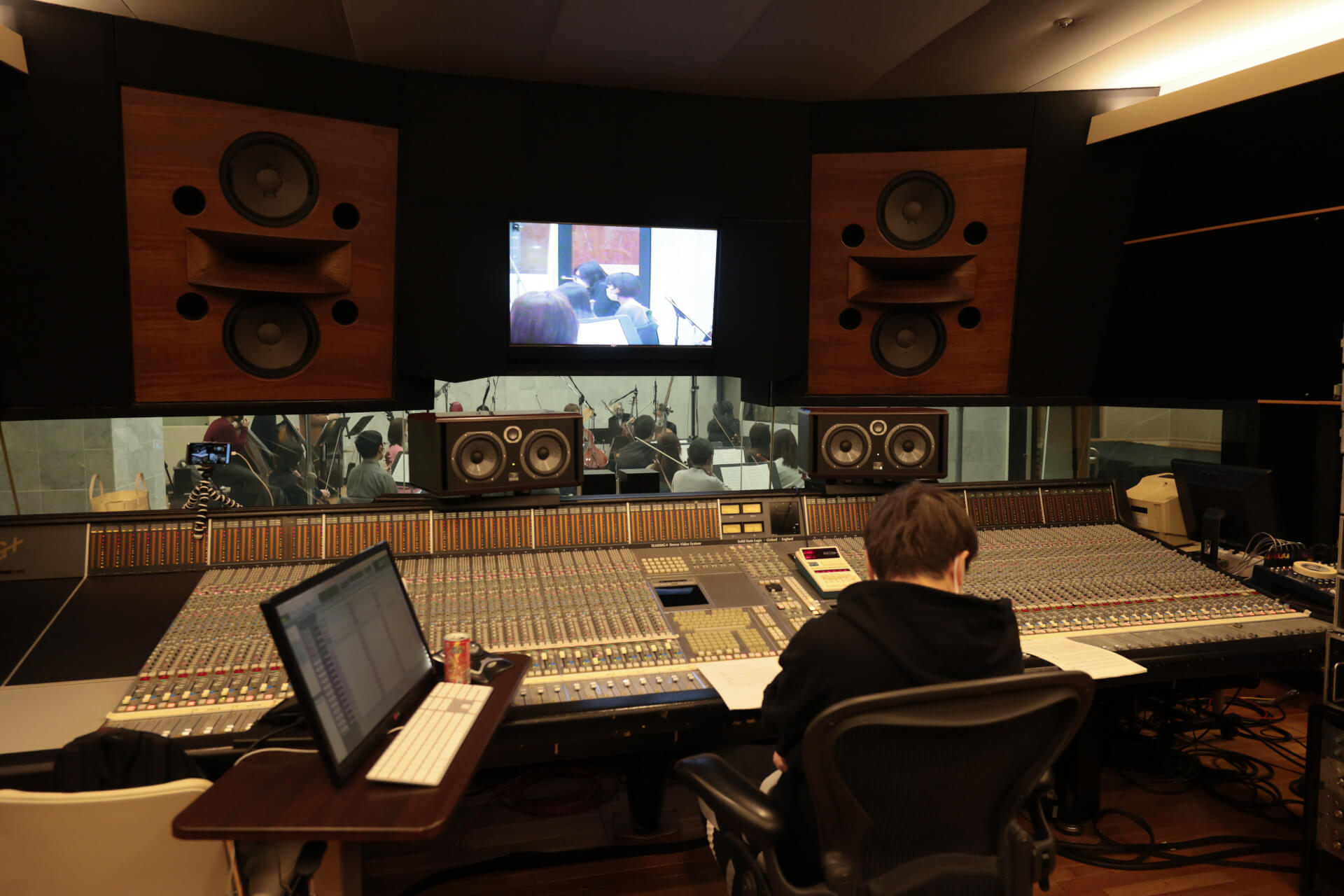
Aizawa: First of all, the volume of the rooms is so different that a simple comparison is difficult. Sound City is less than half the size of Abbey Road and Synchron Stage, so you simply can't capture that same sense of distance, and the early reflections at Sound City are faster. However, because it's more compact (though still a large studio by Japanese standards), it's a bright and resonant room, giving it the flexibility to go in either direction.
If you want an orchestral sound, you can craft the mix while imagining the spaciousness of Abbey Road. If you focus primarily on close mics, it can also handle fast passages well. I think anyone who understands how it resonates can control it very well.
Yokoyama: Capturing the specific acoustics of Sound City is a unique Japanese point and a defining feature of this library.
SONICWIRE: Mr. Aizawa, were there any specific points you paid attention to or prioritized during this recording?
Aizawa: During recording, in addition to the main condenser mics for the close positions, I also used ribbon mics.
Since Sound City is a very resonant studio in Japan, if we just let it ring out natively, there might be too much reverb for fast-passage tracks. So, the premise is that we want the users to skillfully control the balance using the close mics.
While ensuring the sounds can be used for any approach, I personally love my own sonic footprint — things like saturation — so I captured the strings with a bit of that flavor added. I also placed additional mics in positions I don't normally use, intentionally setting up mics that can be assigned to surround positions.
SONICWIRE: Did the environment for this solo recording change from when you recorded Tokyo Scoring Strings?
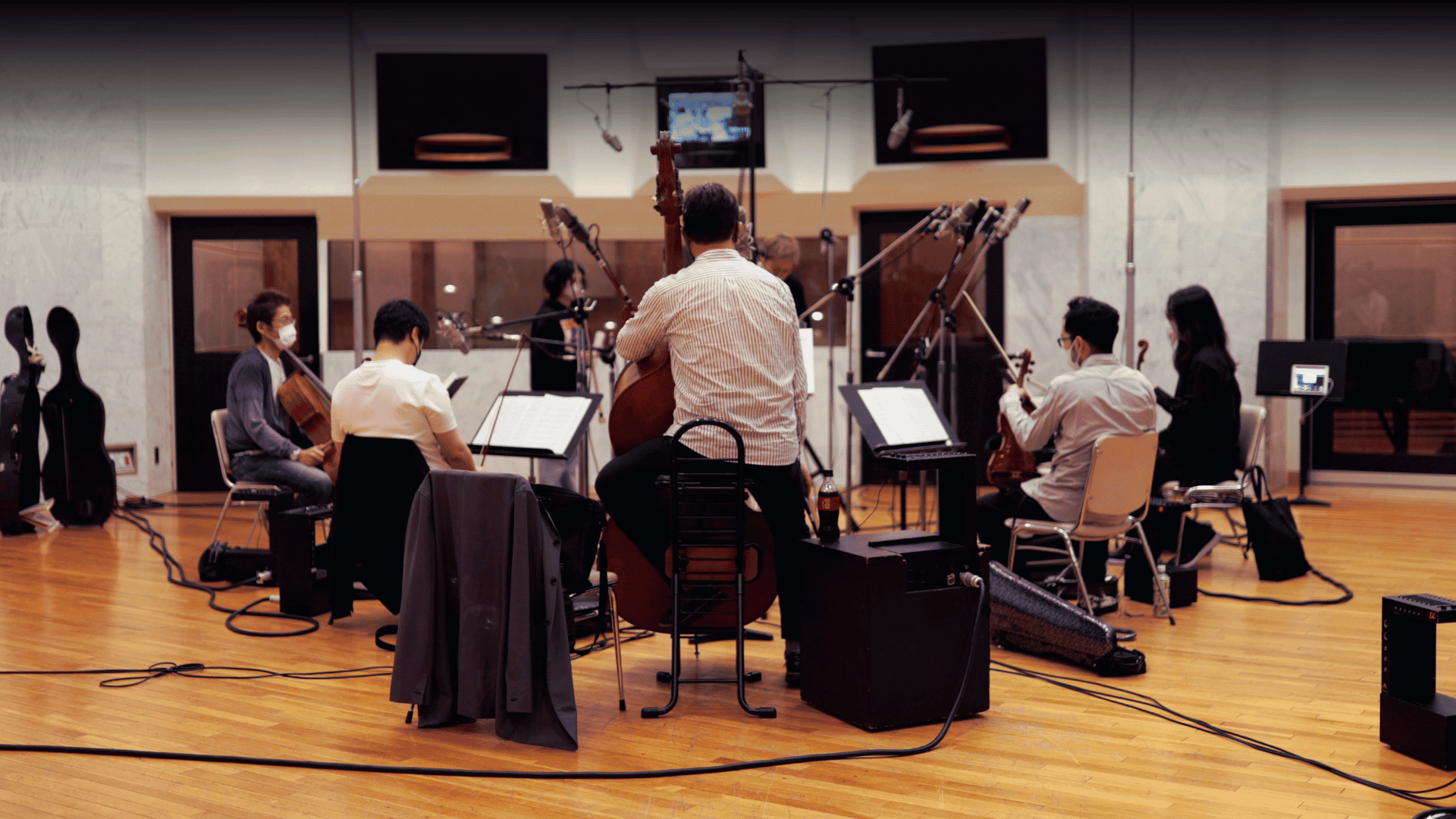
Aizawa: We recorded in the same spot at Sound City as the section recordings. The setup simulated a quartet layout, but placed slightly closer together. In terms of gear, it was essentially the same as last time; I used my own equipment and matched the types of microphones.
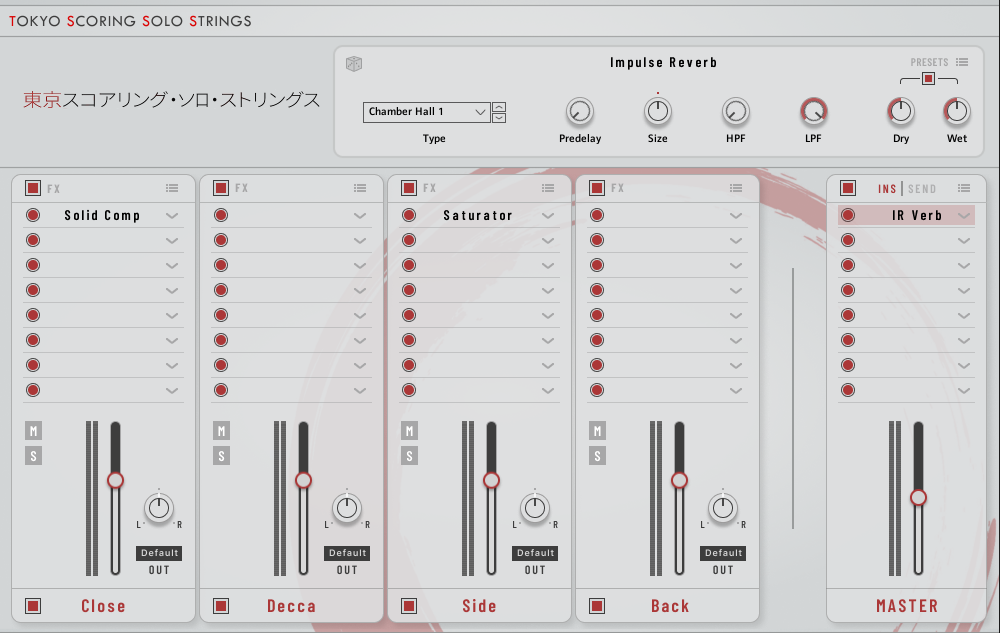
Yokoyama: Speaking as a composer, we usually mix about three types of mics — close, Decca tree, and ambient [hall] — but Mr. Aizawa sets up mics in even more layers. In short, it means "preparing many options right from the start."
Aizawa: Yes, exactly. It's about broadening the scope. People might think you need extensive knowledge to handle it, but simply tweaking the mixer a bit will make it sound better. I want users to realize, "I can control this."
SONICWIRE: Conversely, could you summarize the strengths and benefits of recording in a Japanese studio (like Sound City)?
Aizawa: The strength of the Japanese sound is its versatility — it’s very easy to control. You can shape it to handle fast passages, or use the depth for orchestral-style tracks. Overseas recordings can sometimes sound too wide, but from an engineer's perspective, Sound City provides a highly controllable sound.
SONICWIRE: Mr. Yokoyama, what was your frank impression when you actually played the library?
Yokoyama: The immediate sound right out of the box is exactly "the sound of Mr. Muroya recorded by Mr. Aizawa at Sound City." Because I know that sound so well, my reaction was, "Ah, yes, this is that sound."
Playing the library, I truly felt it has become one of the very few options that perfectly fits the scale and vibe of Japanese anime. You can distinctly feel "Mr. Muroya's essence," "Mr. Aizawa's essence," and the "Japanese essence" from this product. That is an undeniable fact.
At the same time, I realized once again that the sheer volume of musical information Mr. Muroya processes during a live recording is simply in a league of its own.
Muroya: When recording a single quartet part, from my perspective, all the information — both musical and technical — is laid bare with nothing to hide behind. Therefore, I want users to take their time through trial and error to shape their sound. When they press a key, "my sound" comes out. I'm excited and looking forward to seeing how everyone will craft my sound.
SONICWIRE: The fact that you instantly hear "Mr. Muroya's sound" the moment you play it is, I think, the strongest selling point of this product.
Feedback and Human Strengths
SONICWIRE: Mr. Muroya, have you received any feedback since the release of Tokyo Scoring Strings?
Muroya: The feedback has been great. Also, I've noticed that composers I work with use the exact same library, yet their sounds turn out completely different.
Some people said, "Since Mr. Aizawa recorded this at Sound City, maybe I should book a different studio for my live players." But actually, [when layering live instruments with Tokyo Scoring Strings], it blends much better if you layer sounds recorded at the same Sound City.
Rather than mixing sounds from different studios, unifying them with the same room acoustics makes it blend naturally, allowing you to purely increase the perceived section size. This was a surprising discovery.
SONICWIRE: In meeting the demands of various genres and requests from around the world, where do you think your strengths lie?
Muroya: For each project, I love synthesizing the nature of the track, the studio environment, and the engineer's style to create the sound. My strength probably lies in fulfilling what is required while still injecting my own personality and fitting it perfectly into the mix.
Japanese composers around our generation demand grand expressions, but they are surprisingly meticulous about mistakes and minor details. Under those conditions, delivering the required performance — like nailing it on the first take without mistakes — is tough.
However, when we master phrases we initially thought unplayable, the next generation of composers starts writing music with the premise that those phrases can be played flawlessly. That pushes our skills even higher. I think this is a great positive feedback loop.
SONICWIRE: So you anticipate what might be lacking for the team as a whole, stay one step ahead, and adapt perfectly to the situation. And the ability to direct that process is your strength, a structure that is unique to Japan. One last question. What do you consider to be the "greatest value of live recording and live performance"?
Muroya: With live performance, it's definitely the "sense of tension." You are processing a massive amount of information under tension and accomplishing the goal. I truly feel that live performance is an art of the moment.
When users play this library, if they approach it with a mindset like, "I absolutely cannot make a mistake here," or "Once I paint with this color, I can't erase it," they might actually create something very close to a live performance. The vibe, so to speak.
Conclusion and Messages
SONICWIRE: Finally, could you each give a brief message to Tokyo Scoring Solo Strings users and creators who are interested in it?
Yokoyama: I would be thrilled if this library serves as a gateway, an opportunity for various composers to actually experience working with Mr. Muroya, Mr. Aizawa, and the Sound City recording environment.
The other aspect is the Japanese studio culture itself. We have Sound City, which has continuously innovated within certain constraints; Mr. Aizawa, who insists on crafting textures, even applying saturation to strings; and Mr. Muroya, who has consistently met difficult demands. That accumulation has become history, layering up to form a unique culture.
I hope you experience all of that through this product.
Aizawa: I hope not only Japanese users but also people overseas will use this library and get to know the "Japanese sound." Also, I simply want you to get your hands on the product and truly master it. I believe it will greatly broaden your creative horizons.
Muroya: It’s the sound of Mr. Aizawa, whom I always rely on, and the sound of Sound City — played by me on the instruments I actually use. I cannot personally assist you with your sound design, but I have high hopes that if you study my performances and deepen your understanding, my sound will truly come alive in your hands.
About the Creators
Koichiro Muroya is a pioneering violinist and violist with over two decades working in game audio and anime soundtracks. In addition to his recording work, which dates back to Fromsoft’s Tenchu: Wrath of Heaven in 2003, he is the founder and leader of Koichiro Muroya Strings.
Koichiro Muroya Strings has become the most in-demand session ensemble in all of Japan, and such a dynamic force in the world of game and anime music that it has come to exemplify the “Japanese sound” for discerning audiences all over the world. Members of this ensemble are the featured performers on Tokyo Scoring Strings and Tokyo Scoring Solo Strings.
Mitsunori Aizawa is Japan’s top engineer. With a career stretching back to 2004, Aizawa’s work can be heard on numerous soundtrack albums in games, anime, and beyond. His work on classics like BLEACH, Mobile Suit Gundam: Iron-Blooded Orphans, and Attack on Titan have made him one of the most sought-after producers in the country for recording and mixing alike.
Masaru Yokoyama is a renowned anime and film composer. His 20-year career has included classics like Your Lie in April, Mobile Suit Gundam: Iron-Blooded Orphans, and the new Urusei Yatsura as well as global hits like Umamusume: Pretty Derby and the recent Netflix film 10DANCE. In addition to his success as a composer, he has considerable experience recording scores around the world through his companies Plugnote and MiracleBus.
Crypton Future Media is a Japanese music technology company known for the VOCALOID voice synthesizer software, especially the internationally acclaimed Hatsune Miku. SONICWIRE is their online store and media presence. Impact Soundworks has worked closely with them for years as our Japanese distributors and partners, and they played an essential role in the creation of the Tokyo Scoring series.